Restaurant Wars: Guu vs. DonDon Izakaya

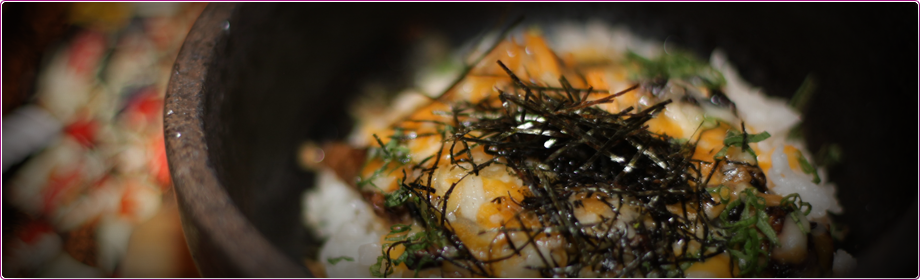
image from guu-izakaya.com/toronto/

When Guu opened it’s first Toronto location in December 2009, people (many of whom were familiar with the original Vancouver chain) went crazy for it’s Japanese sharing plates, communal tables and exuberant service. The first time I went, I spent an hour and a half waiting outside in the snow for a table, freezing my toes off. I was an unpaid intern at the time so I had no money for dinners out, but I was lured by the incessant buzz. It didn’t disappoint. The food was salty, rich and satisfying (a perfect fit for a pint of Sapporo), and the room felt raucous and fun (especially for a city as reserved as Toronto). The second time I went, I liked it just the same (even though the wait was still close to an hour).

Now, seemingly cashing in on the Japanese pub craze that Guu started, a new izakaya has opened: DonDon. I went to check it out the past weekend. Here’s my point-by-point comparison.
Continue reading

An openly gay jock? Yes, it’s possible.

Today, I read about a young gay athlete from Ottawa named Scott Heggart, and have just watched some of his many YouTube videos detailing how he came out to his friends and family. I am really impressed by how articulate he is, especially at such a young age. He started making his video journal when he was 15, and he’s now 19.

I’m also impressed by how brave he is. As an athlete who plays aggressive team sports like hockey, he must have felt immense social pressure (whether explicit or implicit) to suppress his feelings and try to be straight. He seems like a regular, quite masculine teenager (the kind that no one would ever suspect of being gay), so he could have probably coasted for years and years without ever needing to tell anyone. No one would have blamed him if he had chosen to wait until after college, or after he moved out of his parent’s house, or until after he relocated to a bigger, more gay-friendly city. But in choosing to be open about his sexuality at such a young, vulnerable age, he’s done something extraordinary, and will no doubt inspire others.

Continue reading

Beijing To-Do List

I have to admit that booking a trip to Beijing was somewhat compulsive. I’ve just started a new job and the airfare is quite expensive. But a friend of mine is going to be living there for the summer, and casually mentioned over lunch a few weeks ago that if I wanted to come for a visit, I could stay with her for free. Who could say no to a free room? Although I know very little about Beijing, I’m really excited to be going, and I’ve started putting together my to-do list. Of course, The Great Wall of China, Beihai Park and the Forbidden City are high priorities, as is a walk through one of the surviving hutongs and trips to the 2008 Olympic venues (The Bird’s Nest and the Water Cube). Here’s a few of the other things I’m thinking:

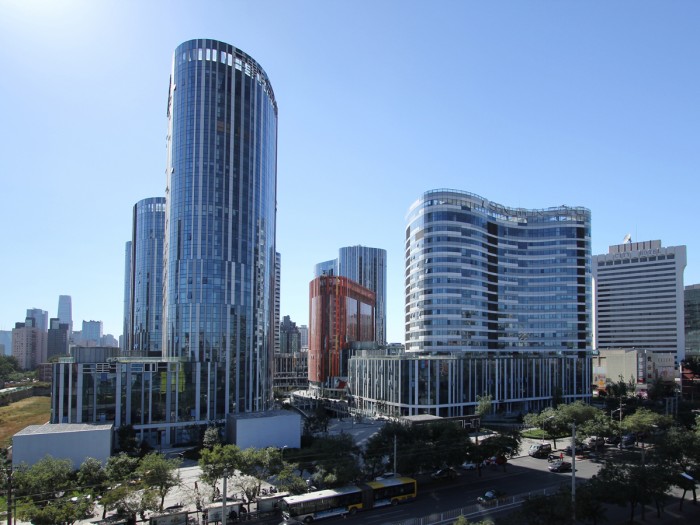
Sanlitun Soho by Kengo Kuma

When I was finishing architecture school, I basically stole the design for my final year project from Japanese master Kengo Kuma. But I’ve never seen one of his projects in person (I’ve just been a fan from books and magazines). I’m not sure if his Sanlitun Soho is one of his best works, but I’m curious if his spaces are as graceful in person as they are in architecture magazines.

Continue reading

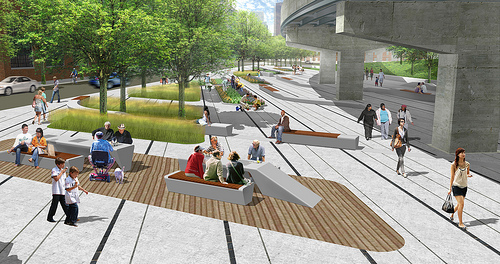
Toronto’s Underpass Park, Making the Gardiner Livable

Toronto has an intensely divided love-hate relationship with the Gardiner Expressway, one of its major thoroughfares. Some people want to tear it down, others think it should be widened. Asking people what they think of the road is often an easy way to find out where they fall politically—lefties think its a blight, conservatives think we need more like it.

I can remember in 2008, then-mayor David Miller pledged to remove the eastern portion, between Jarvis Street and the Don Valley Parkway. It was, in the end, just a fantasy, and since the city’s politics have now moved back to the right with Mayor Rob Ford, the Gardiner is definitely not going anywhere. There have, however, been some interesting changes lately. No, we aren’t putting a strange, garden-bonnet over the road (as one local architecture office, Quadrangle, suggested we do a couple of years ago). Instead, a new park is nearing completion under the eastern-most portion of the road. Aptly called Underpass Park, the space will have a skate park, basket ball nets, and a playground. It won’t officially open until the summer, but the Toronto Star‘s Christopher Hume recently released a video preview. Can’t wait to check it out soon for myself!


Copper Lamp Shades

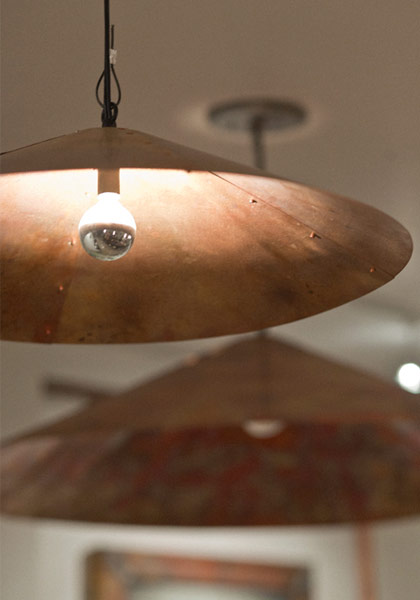
Copper Lamp Shades at Yours Truly

Photo by Riley Stewart, via torontolife.com's The Dish blog

Similar to the many other ultra-buzzy, independent restaurants that have opened in Toronto over the past couple of years, Yours Truly (229 Ossington Ave.) is a closet-small room run by a 28-year-old chef and a wait staff that was all born in the ’90s. And the decor is full of salvage and not terribly practical. To wit, when I went a few weeks ago, I had to lay my jacket on the floor behind the stool I was sitting on because there was no coat rack. I was, however, delighted by the different-sized copper lampshades that dot the ceiling. The shades have a simple but interesting shape and, of course, being copper, will develop an interesting patina overtime (because the food was so good—so good! Parsnip mousse = yummy—I’m sure I’ll be back to see the change). The restaurant was designed by Toronto’s Stroudfoot, which has done other quirky-beautiful restaurants including Origin and Colborne Lane.

Beijing Taxi

I just finished watching Miao Wang’s excellent documentary Beijing Taxi. The film both lovingly and critically looks at the changing face of China’s capital through the eyes of three different taxi drivers—a soon-to-retire, smiley older man; an easily contented, middle-aged guy; and an ambitious but frustrated mother. The impression that the movie gives of Beijing is very hazy—both literally (because the city is polluted) and figuratively (because the streetscape is changing drastically, right before the camera’s lens). Huge buildings are being putting up alongside massive, congested highways, and in the time span of the movie (two years) progress is definitely measurable as a function of what’s been added, as well as what’s been removed (the rubble is piling up where older, smaller buildings used to be).

The film was started a couple of years before the 2008 summer Olympics. The iconic venues—the Bird’s Nest, in particular—are a point of pride for the locals and yet look totally alien (they definitely don’t blend into the city and have a distinct air of removal from anything remotely status quo). And as the games get nearer, the city starts to look cleaner and neater and more welcoming. I wonder if that sheen has remained?

Continue reading

Beijing, My Invisible City

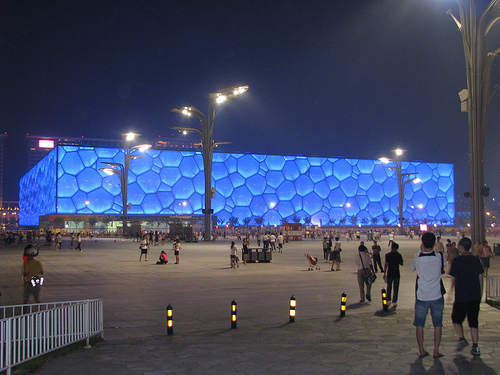
Beijing's Water Cube, photo by Wilson Loo

At the end of May, I’m going to Beijing for two weeks. I’ve never been to China before. I’m going to be visiting a friend of mine from University. It’s interesting because unlike other global cities such as New York, London, Paris—places that long before I ever saw them in person, I had seen them repeatedly in film and on TV and in magazines and newspapers—I have almost no real imagination of what Beijing is like. I can’t picture how the streets feel or what the everyday architecture (houses, schools, offices) might be like. Of course, I know some of the iconic buildings from the 2008 summer Olympics (the Bird’s Nest and the Water Cube), as well as the Imperial Palaces of the Forbidden City and the uncanny, Rem Koolhaas-designed CCTV building. But those are all otherworldly oddities (I’m assuming) in the city, and not what you would see walking down your average street (whereas in New York, I was familiar with brownstone walk-ups from the age I started watched Sesame Street). So when I picture Beijing, I draw a blank. But I also feel that visiting Beijing right now is in someway visiting the centre of the earth—the new control centre for the global economy (sorry Washington, Manhattan and elsewhere). So I can imagine that whichever part of the city I go to there will be rumble of construction underfoot, and everything changing all around me almost as fast as I try to register how it is.