Hipster How-To: Getting the Look of HBO’s Girls

In the first episode of HBO’s much-hyped new dramedy, Girls, the central character, Hannah Horvath, quips “it costs a lot of money to look this cheap.” The line is borrowed from Dolly Parton, but instead of too much makeup and rhinestone-studded clothing, Horvath (played by the show’s creator Lena Dunham) and her friends wear disheveled vintage rags (from the best stores) and carefully blend a Hippie nomad/world-weary artist/spoiled preppy aesthetic (think drape-y blouses, fedoras and broad-shouldered overcoats). They live in bourgeois-bohemian squalor in the hipster-packed neighbourhood of Greenpoint, Brooklyn. Horvath shares an apartment with her roomate Marnie Michaels, and their place suits their clothes: slightly rusty chairs around a Saarinen tulip table; a bathroom decked in trendy white subway tiles with a gaudy floral shower curtain. Horvath’s boyfriend, Adam Sackler (whose last name, fittingly, is an obvious anagram for slacker), is a carpenter-actor-louse whose apartment is even more elegantly disheveled: a tarnished mirror, an typewriter, scraps of his carpenting wood, a plush but ratty settee.

Continue reading

Architecture Envy: Vancouver vs. Toronto

Big, Beach and Howe

It’s possible to say that I’ve had an intimate relationship with both Toronto and Vancouver. I was born in Canada’s largest city, and have lived here on and off (currently on) for my whole life. It’s my steady, and I love it the way I love an old, comfortable sweater. I’ve also traveled west a few times to visit. There’s something about all the mountains and trees that used to really spark my imagination. But my most recent trip to Vancouver — a three month stint in 2008, when I was on a university work term — cured me of any desire to live on near the pacific. It’s pretty, true. Yet aside from the great skiing and hiking, it can be kind of tedious. How many lattes can someone drink without wanting a bit more edge? I have to admit, however, I’m a little jealous right now of a couple of their architectural projects. Might make a trip necessary again in the future.

Continue reading

Weird Things Inspired by Modern Architecture

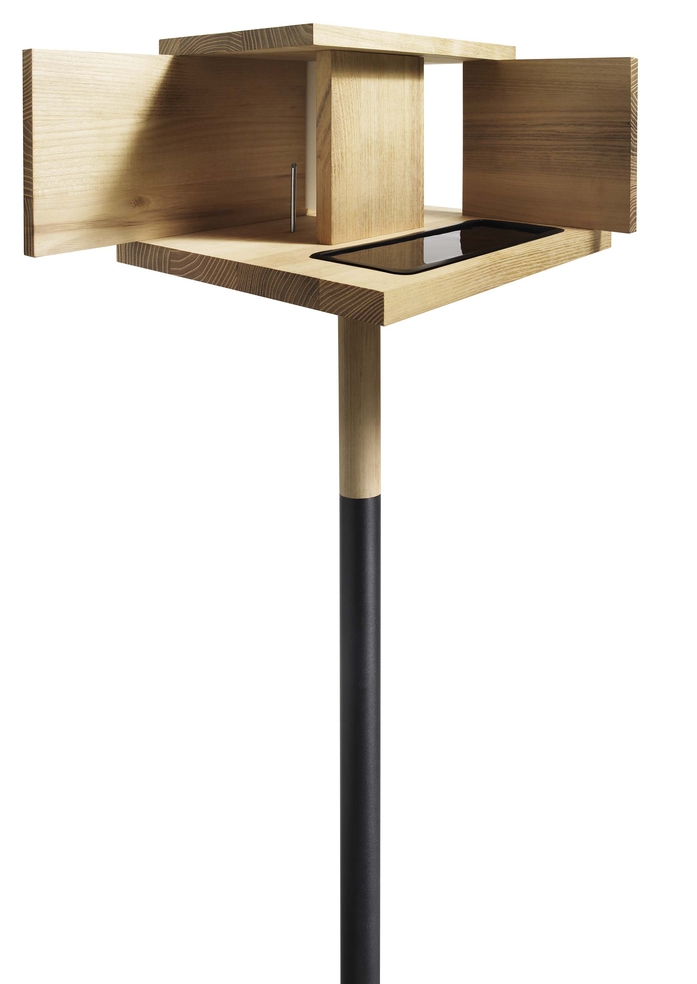
Modern architecture is often derided for being austere, yet over the past few years, I’ve definitely noticed some clever, playful things inspired by the work of Mies van der Rohe, Arne Jacobsen and Le Corbusier. Toys, gingerbread houses and even a bird house have brought a certain down-to-earth charm to some of the most iconic buildings of the twentieth century, making them more accessible to people who wouldn’t necessarily know the difference between Ronchamp and Fallingwater. Here are some of my favourites.

If I had a backyard with birds in it (especially birds wearing black turtle necks), I would definitely buy Monique Engelund‘s tribute to Mies van der Rohe’s Barcelona Pavilion.

Continue reading

A Rigorous Sort of Happiness

Mavis Gallant at the Standard, Montréal, May 1946 (courtesy Library and Archives Canada/PA-11524).

I’ve never read a Mavis Gallant short story, something that, as I write this blog post, I’m ashamed to admit. But every so often I come across a mention of this escaped Cannuck — who has lived in Paris for over 60 of her 90 years — that re-asserts her importance in the world of writing. As a result, I have a certain sketchy understanding of her life through the Globe and Mail, the Walrus, the National Post and other media outlets. The first time I really took notice was in a charming 2008 radio interview on CBC’s Writers and Company, but it wasn’t until last week, when I listened to another CBC radio interview on Ideasthat her life strongly resonated with me. She seems to have achieved something that I find deeply admirable — independence — and I wish I knew how to do the same.

Continue reading

Titanic Revisited (Or Not)

I just finished reading a review of Titanic by Slate Magazine’s Dana Stevens. The review is premised on the fact that when James Cameron’s epic was first released in 1997, Stevens snubbed it for being “a schlocky, sentimental blockbuster that would force [her] to listen to that Celine Dion song again.” She claims, admittedly snobbishly, to have been too busy with her nose in Walter Benjamin to see the movie in theatres, and, before its current 3D re-release last week, only ever half watched it on TV while distractedly folding laundry. Stevens goes on to admit, however, that after finally seeing it on the big screen, she can understand the mass hysteria that surrounded the film 15 years ago. “Titanic isn’t subtle or tasteful or novel,” she writes “but it’s indisputably big and bold and beautiful.”

Continue reading

Katimavik, I Love You

Last week Canada’s Federal Government, in its first majority budget, announced that it would cease funding Katimavik. I’m sad for all the future young people who will not be able to participate in this great, 35-year-old program—an invaluable volunteer-leadership initiative that enables Canadians between the ages of 18 and 21 to get hands-on work experience while traveling the country.

I did Katimavik between the winter and summer of 2004. Over seven months, I lived in Tweed, Ontario, St. Stephens, New Brunsick and Lorette, Manitoba. I volunteered at an elderly care facility, a charity second hand store, in a primary school and for a municipality. I learned, among other things, how to bake bread, tend a lawn, grow vegetables and organize a charity fashion show. I even published my first piece of paid writing. It was a short article for a Winnipeg magazine called Swerve (now OutWords), and was about coming out of the closet and marching in my first Pride parade, two of my biggest Katimavik firsts (next to my first piercing—my tongue!). My Katima-group, which consisted of 11 young people from across Canada, had three gay guys and two bisexuals. I couldn’t have come out in any better, more supportive circumstances. I (almost) had my first real sexual encounter too (if drunkenly molesting a housemate counts—sorry Cody).

Continue reading

Getting to Know Andy Warhol

The Andy Warhol Museum, front facade, 1994, photo by Paul Rocheleau

On Saturday, after I spent the morning at Fallingwater, I went to the Andy Warhol Museum in Pittsburgh. Here are my thoughts on the experience:

To a certain extent, I feel like I’ve grown up in a time heavily influenced by Andy Warhol. My world view had been undeniably filtered by the celebrity-drenched culture that he explored, documented and, dare I say, championed. I’ve lived my fifteen minutes of fame on Facebook, YouTube, Twitter and now this blog. When I visit almost any major art gallery in a foreign city (or, for that matter, in my hometown of Toronto), I inevitably find one or more of Warhol’s most iconic silk screens — the soup cans, the Marilyn Monroes, the Liz Taylors, the Maos, the Evlises, the Jackie Kennedys. But even if I don’t see one of his pieces directly, I am bound to see something by one of the legions of artists that he either directly mentored or inspired (Basquiat, Keith Haring, Jeff Koons, Damien Hirst and so on).

Continue reading

Frank Lloyd Wright’s Fallingwater

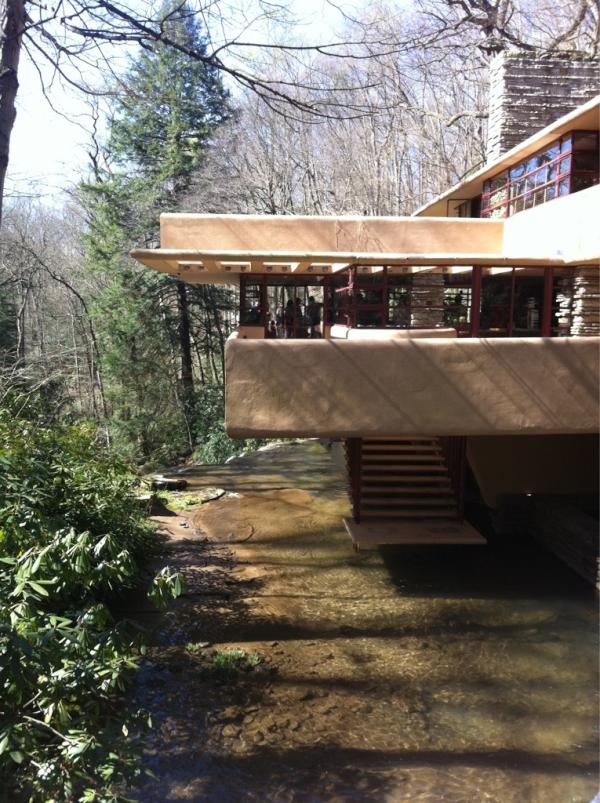
On Saturday I made an architectural pilgrimage to see Frank Lloyd Wright’s Fallingwater in Mill Run, Pennsylvania. The drive down from Pittsburgh, where my boyfriend and I spent the weekend, rolled though tree-covered hills and small, quaint farming communities. It was so restful and pleasant that I almost forgot where we were headed and why.

The tour of the house is only and hour long, but it’s undeniably worth it. The place is like a mid-century modern fantasy land, with bold horizontal lines in rich black walnut, rough-cut stone, ochre-coloured concrete, and dark red window mullions. There is a deep, comforting warmth to the rooms (this isn’t a cold, hulking, Corbusier-style modernism) and at times an almost Victorian feel. The hallways are tight and dark, and there’s an upstairs/downstairs divide between the servants quarters and the rest of the place that feels really old fashioned (the house was designed in the 1930s, which is easy to forget considering that it feels much more contemporary). There’s also a sense of playfulness and levity—the built-in sofas have a cream-coloured upholstery, and are cheerfully accented with square pillows in ketchup-y red and mustard yellow. Most remarkably, walking from room to room, there is just such a clear and palpable feeling of enthusiasm—it’s clear how much Frank Lloyd Wright enjoyed crafting the house. It almost comes across as spontaneous, like jazz, or as though the design just popped out of his head like a witty turn of phrase.

I hope the clients—the Kauffman family—enjoyed spending time in its cascading planes and fluid walls. I imagine I would have loved lounging in either of the pools, or deciding which of the many terraces to sit out on to read the latest New Yorker.

Justin Trudeau, You’re Hot

Dear Justin Trudeau,

You’re hot.

I normally don’t find politicians hot. John Baird? Yikes. So scowly. And, let me be clear, I don’t think you’re hot because of your hunky, boy band good looks (seriously, were you ever in 98 Degrees?). And it’s definitely not because you’re father was Pierre Elliot Trudeau (although he was hot too), or because you can box (not that it hurts), or because you’re over 40 but still look good with your shirt off (although, again, that definitely doesn’t hurt).

Continue reading

Toronto Real Estate, WTF?!

The Grange Park, photo by wyliepoon

Last Sunday night, before the sun went down, my boyfriend and I decided to stroll through my favourite Toronto neighbourhood and casually look for a new place to live. Right now, we rent a 1950s, 800-square-foot, ground-floor apartment near Sherbourne and Bloor. It’s a nice spot (we have our own garden and the building is quiet), in a nice area (we’re caught in a sweet spot between subway access and a lush, peaceful ravine). But I’ve always loved the neighbourhood around the Art Gallery of Ontario, at Beverley and Dundas West. The streets — leafy with lots of Victorian semis — are incredibly charming, and it’s near the Grange Park, OCAD, U of T, Kensington Market and Chinatown. Plus, my boyfriend and I are getting to that stage in life where renting is starting to feel too student-y (he just turned 30 and everyday I feel my 20s slipping away).

The first For Sale sign we noticed was for a tumble-down brick bungalow the size of Timbit. It looked a bit sad, with a yard of concrete pavers enclosed by a wobbly chain link fence. But before I could utter the phrase fixer upper, I was choked by the price. Over half a million dollars. The revelation made me feel both insulted and poor. I briefly tried to rationalize the price — good location, cute shape (with a little peaked roof) — then my brain started to hurt, so we moved on.

Continue reading