A House I’ll Never Own or Decorate – The David Bowie Dream Home Edition

Shim-Sutcliffe’s Weathering Steel House. Photo via http://dereknicholson.com.

In real estate, as in love, there are homes that you have a fleeting crush on, ones that you want to have a family with, and others that are just so out-of-your-league gorgeous they become the stuff of fantasies. Such is the case with 87 Highland Crescent, which I’ve loved from afar for years and which is now on the market. Am I going to be placing an offer? Given an asking price of $6.85 million, I’m afraid my feelings will have to go forever unrequited: with Canada’s maximum 25-year mortgage terms, even if I (miraculously) had a 10 per cent down payment, and borrowed the $6.2 million balance, every month I would have to give the bank about $37,000 (assuming a reasonable interest rate of 5.24 per cent per year). $37,000. A month. That’s more than my yearly take home pay. The only way I could swing that would be to invent a time machine, go back about 10 years, and tell my teenage self all about Facebook so I could scoop Mark Zuckerberg. Anyway, the house actually appeared on the market two years ago at a higher price — $7.995 million — so whichever gazillionaire buys it can sleep easy on his mountain of money knowing he got a relative deal. David Bowie is rumoured to be a fan of the home’s architecture, so maybe he’ll snag it for Iman. Sigh, below is why I love it so much.
Continue reading

OMA’s Milstein Hall at Cornell University

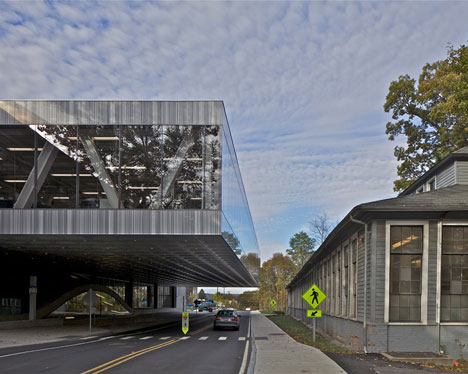
Milstein Hall at Cornell University. Image from dezeen.com. Photography is by Philippe Ruault

Last week, on my way down to New York City, I stopped at Cornell University to see their new Architecture, Art and Planning building, Milstein Hall. The OMA-designed facility looks like a Mies van der Rohe-style box propped up on a concrete ant hill, floating not incongruously between the kind of Victorian and Georgian structures one imagines at an Ivy League school. Some of the design is quite subtle — part of the exterior is clad in elegantly stripped Turkish marble — while some of it is showy and loud — a giant, 50-foot cantilever reaches over University Ave., almost-but-not-quite touching the 150-year-old Foundry Building across the road. I wasn’t sure if this latter gesture was an act of aggression — like a bully announcing its presence to a meek, helpless victim — or one of kindness, like an outstretched hand between a young spunky kid and an old, fair lady. This ambivalence basically describes my reaction.

What I liked: The building is porous. As people walk or bike by, there are interesting opportunities to look into spaces that are normally much more cloistered in a school: a lecture hall that has windows on three sides, or a submerged auditorium/crit space with large clerestories.  Continue reading

New York To-Do List

Over the Victoria Day long weekend, my boyfriend and I are driving down to New York City. We’ve gone every year for the last four, and each time we visit we discover new reasons to love the city. In 2011, for example, we rented road bikes and toured around Manhattan, then crossed over the Brooklyn Bridge, checked out Prospect Park and went down to Coney Island. It took us a whole day and we were exhausted by the time we hit the Atlantic, but it was great. We were both impressed by the miles of dedicated bike lanes that made cycling feel so much safer than in our home town of Toronto.

We might bike around again, but I think this trip is going to be more arts and culture focused. Here’s what we’re thinking of seeing.

Milstein Hall at Cornell University

Milstein Hall by OMA

Continue reading

A House I’ll Never Own or Decorate – The Bedroom Dance Party Edition

Thanks to a combination of factors — a deep-rooted fear of debt, my poor choice of career paths and an over-inflated real estate market — It’s a foregone conclusion that I’ll never be able to afford a house in Toronto. And if I did buy, it would likely be a bachelor condo the size of a hamster cage on the fringes of civilization (heaven forbid, somewhere north of the 401). I’m picturing a life where I’m too poor to hang curtains or buy any furniture, yet too stressed by my massive mortgage payments and claustrophobic digs to even care. So while I can’t buy a house, I’ve decided to torture myself with indulge in fantasy real estate — basically, from time to time, I’m going to be picking the places that I’d like to buy, and blogging about how I would decorate them to make them my own.

The Place: 15 Crocker Ave., a two-bedroom, $519,000 Victorian townhouse near Trinity Bellwoods. It’s around the corner from Nadège Patisserie, which means I would get happily fat eating too many butter croissants and gin-and-tonic marshmallows. Overall, I like the neighbourhood and think this would be a fun fixer project.

15 Crocker Ave.

Continue reading

Toronto Real Estate: Why Do You Tease Me?

64 Wales Ave., Toronto

The sad fact is that I can not, under any circumstances, afford to buy a house in Toronto. I can barely afford a new pair of runners or wine with dinner. Yet, like a tween girl (or boy) with fantasies of being whisked away by Justin Bieber, I can dream. And I have a serious real estate crush at the moment. It’s a peaked-roofed, brick Victorian row house in Kensington Market, with a garden in the front and bright, clean-lined interiors.

Continue reading

Weird Things Inspired by Modern Architecture

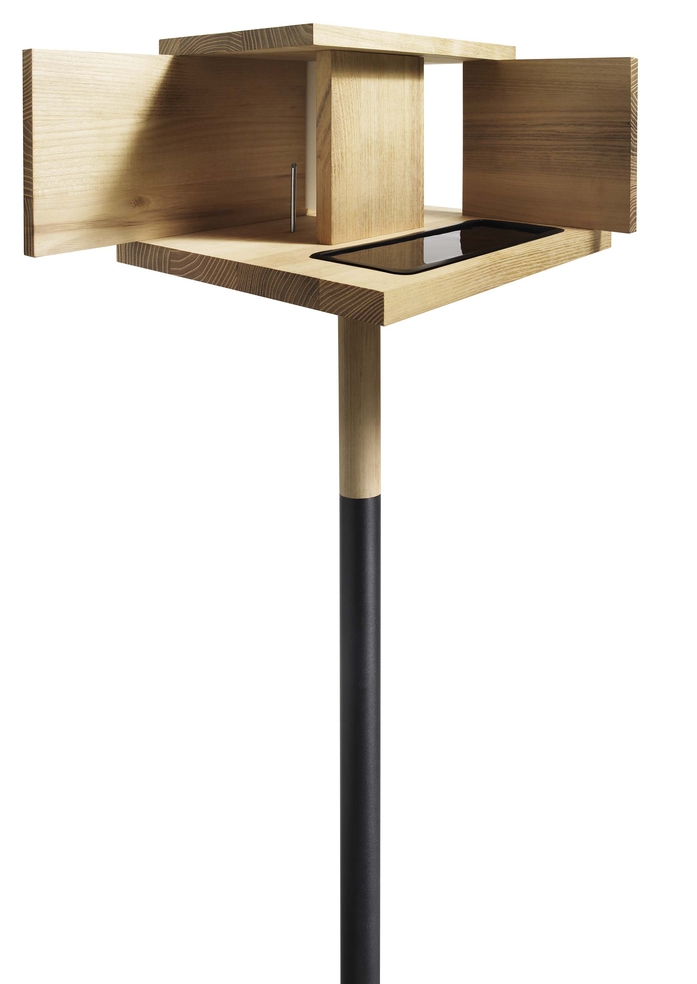
Modern architecture is often derided for being austere, yet over the past few years, I’ve definitely noticed some clever, playful things inspired by the work of Mies van der Rohe, Arne Jacobsen and Le Corbusier. Toys, gingerbread houses and even a bird house have brought a certain down-to-earth charm to some of the most iconic buildings of the twentieth century, making them more accessible to people who wouldn’t necessarily know the difference between Ronchamp and Fallingwater. Here are some of my favourites.

If I had a backyard with birds in it (especially birds wearing black turtle necks), I would definitely buy Monique Engelund‘s tribute to Mies van der Rohe’s Barcelona Pavilion.

Continue reading

Getting to Know Andy Warhol

The Andy Warhol Museum, front facade, 1994, photo by Paul Rocheleau

On Saturday, after I spent the morning at Fallingwater, I went to the Andy Warhol Museum in Pittsburgh. Here are my thoughts on the experience:

To a certain extent, I feel like I’ve grown up in a time heavily influenced by Andy Warhol. My world view had been undeniably filtered by the celebrity-drenched culture that he explored, documented and, dare I say, championed. I’ve lived my fifteen minutes of fame on Facebook, YouTube, Twitter and now this blog. When I visit almost any major art gallery in a foreign city (or, for that matter, in my hometown of Toronto), I inevitably find one or more of Warhol’s most iconic silk screens — the soup cans, the Marilyn Monroes, the Liz Taylors, the Maos, the Evlises, the Jackie Kennedys. But even if I don’t see one of his pieces directly, I am bound to see something by one of the legions of artists that he either directly mentored or inspired (Basquiat, Keith Haring, Jeff Koons, Damien Hirst and so on).

Continue reading

Beijing To-Do List

I have to admit that booking a trip to Beijing was somewhat compulsive. I’ve just started a new job and the airfare is quite expensive. But a friend of mine is going to be living there for the summer, and casually mentioned over lunch a few weeks ago that if I wanted to come for a visit, I could stay with her for free. Who could say no to a free room? Although I know very little about Beijing, I’m really excited to be going, and I’ve started putting together my to-do list. Of course, The Great Wall of China, Beihai Park and the Forbidden City are high priorities, as is a walk through one of the surviving hutongs and trips to the 2008 Olympic venues (The Bird’s Nest and the Water Cube). Here’s a few of the other things I’m thinking:

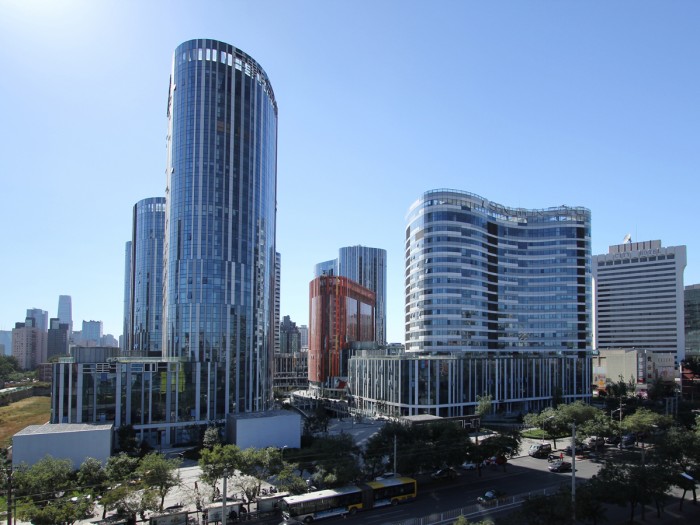
Sanlitun Soho by Kengo Kuma

When I was finishing architecture school, I basically stole the design for my final year project from Japanese master Kengo Kuma. But I’ve never seen one of his projects in person (I’ve just been a fan from books and magazines). I’m not sure if his Sanlitun Soho is one of his best works, but I’m curious if his spaces are as graceful in person as they are in architecture magazines.

Continue reading

Copper Lamp Shades

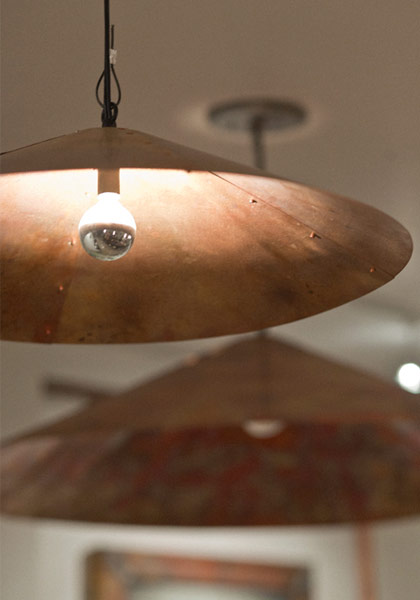
Copper Lamp Shades at Yours Truly

Photo by Riley Stewart, via torontolife.com's The Dish blog

Similar to the many other ultra-buzzy, independent restaurants that have opened in Toronto over the past couple of years, Yours Truly (229 Ossington Ave.) is a closet-small room run by a 28-year-old chef and a wait staff that was all born in the ’90s. And the decor is full of salvage and not terribly practical. To wit, when I went a few weeks ago, I had to lay my jacket on the floor behind the stool I was sitting on because there was no coat rack. I was, however, delighted by the different-sized copper lampshades that dot the ceiling. The shades have a simple but interesting shape and, of course, being copper, will develop an interesting patina overtime (because the food was so good—so good! Parsnip mousse = yummy—I’m sure I’ll be back to see the change). The restaurant was designed by Toronto’s Stroudfoot, which has done other quirky-beautiful restaurants including Origin and Colborne Lane.

Beijing Taxi

I just finished watching Miao Wang’s excellent documentary Beijing Taxi. The film both lovingly and critically looks at the changing face of China’s capital through the eyes of three different taxi drivers—a soon-to-retire, smiley older man; an easily contented, middle-aged guy; and an ambitious but frustrated mother. The impression that the movie gives of Beijing is very hazy—both literally (because the city is polluted) and figuratively (because the streetscape is changing drastically, right before the camera’s lens). Huge buildings are being putting up alongside massive, congested highways, and in the time span of the movie (two years) progress is definitely measurable as a function of what’s been added, as well as what’s been removed (the rubble is piling up where older, smaller buildings used to be).

The film was started a couple of years before the 2008 summer Olympics. The iconic venues—the Bird’s Nest, in particular—are a point of pride for the locals and yet look totally alien (they definitely don’t blend into the city and have a distinct air of removal from anything remotely status quo). And as the games get nearer, the city starts to look cleaner and neater and more welcoming. I wonder if that sheen has remained?

Continue reading